Grey Serpeggiante
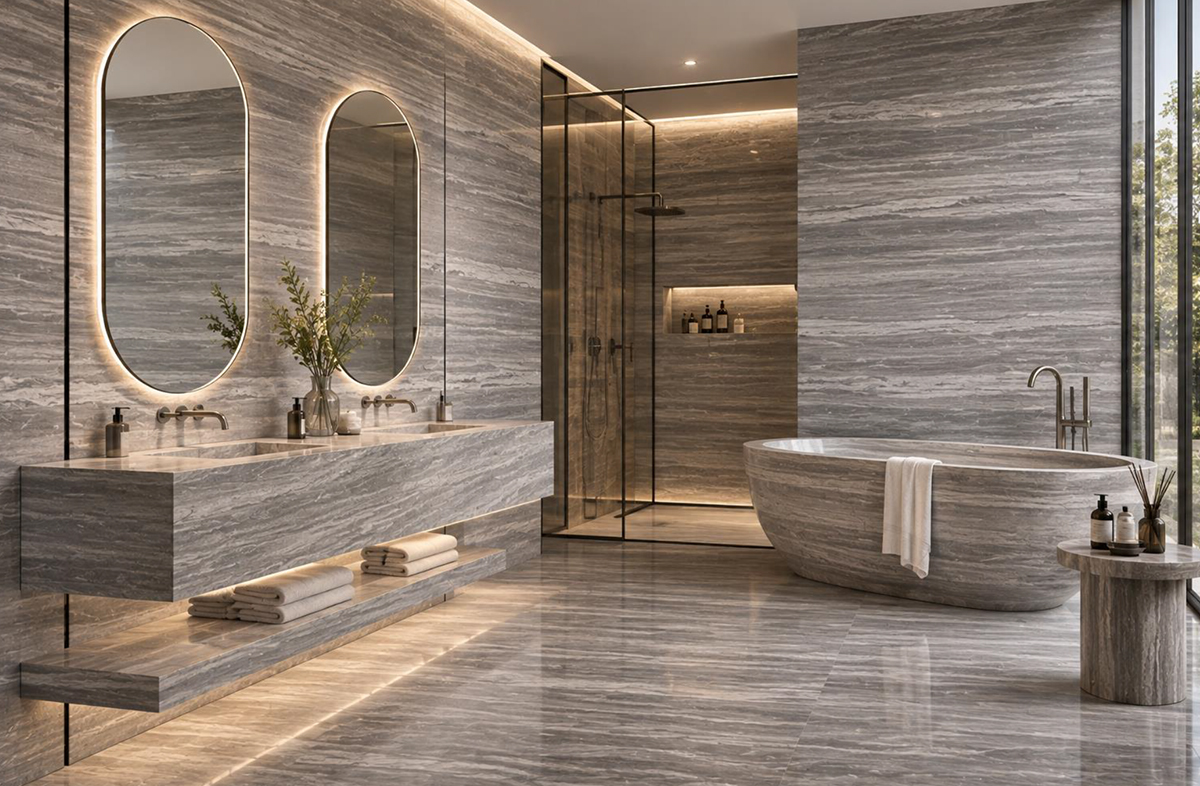
Grey Serpeggiante takes its name from the Italian word serpeggiante, meaning "moving like a snake," and it is a natural stone that fully lives up to this description. The grey-toned version of the classic beige Serpeggiante, this limestone reveals itself at first glance through its linear veins that flow across the surface like the scales of a serpent. The Serpeggiante family, with deep-rooted origins in Italy's Puglia region, is regarded as one of the most prestigious materials in modern interior architecture; Grey Serpeggiante is the more contemporary, more neutral, and more minimalist member of this family.
Origin and Character
Serpeggiante is geologically classified as limestone; however, due to its high density and suitability for polishing, it is frequently referred to as marble. It was formed by the compression and crystallization, through geological movements, of layered sediments that accumulated on shallow seabeds millions of years ago. This layered structure gives rise to the stone's most distinctive feature: its parallel, undulating vein pattern. In Grey Serpeggiante, these veins take on dark anthracite, smoky, and occasionally brown tones against a cool grey base, creating an elegant contrast.
Visual Characteristics
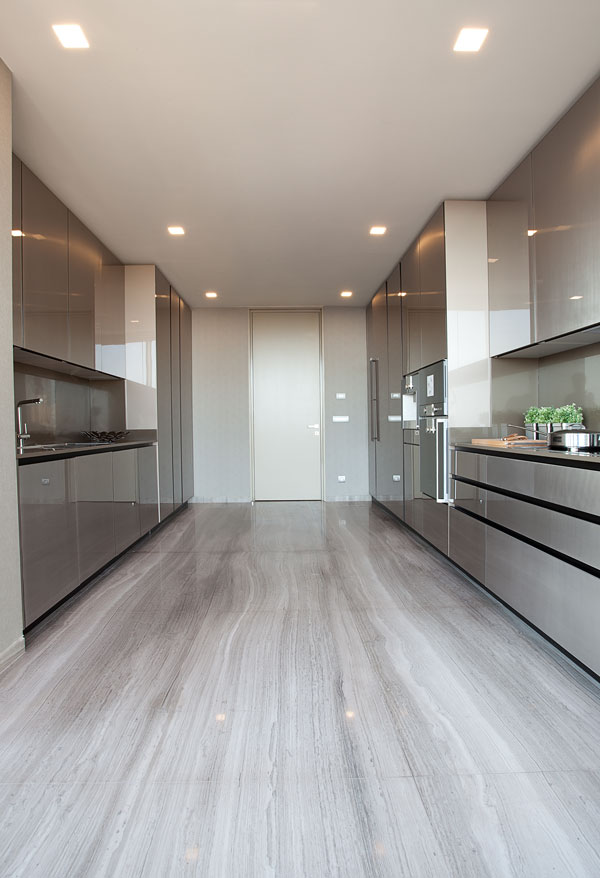
The most striking aspect of Grey Serpeggiante is the rhythmic and predictable flow of its vein pattern. While the base color ranges from light grey to smoke grey, the dark veins running across it bring movement and depth to the stone's surface. These veins reveal two distinct aesthetics depending on how the stone is cut:
- Vein Cut: The veins appear as parallel, elongated lines, offering a layered, dynamic, and modern look. When large slabs are laid side by side, the result resembles a natural stone canvas.
- Cross Cut: The veins transform into irregular patterns reminiscent of clouds, waves, and blossoms, lending a more organic, softer, and classical atmosphere.
These two cutting options make it possible to create vastly different atmospheres from the same stone, providing designers with significant flexibility.
Technical Properties and Durability
Grey Serpeggiante is among the most durable members of the limestone family. Its dense and homogeneous structure delivers both aesthetic appeal and long-lasting performance. Its notable physical and mechanical properties are as follows (based on standard tests conducted at Italian facilities):
- Density: ~2,720 kg/m³
- Water absorption rate: ~0.06% (very low)
- Compressive strength: ~230 MPa
- Compressive strength after freezing: ~199 MPa
- Flexural strength: ~14.1 MPa
- Knoop microhardness: ~1,874 MPa
- Mohs hardness: 3–4
These values position Grey Serpeggiante as a high-density, low-porosity, and frost-resistant stone that can be used with confidence in both interior and select exterior applications. It is generally offered on the market in slab form at thicknesses of 2 cm and 3 cm, as well as in various tile and mosaic dimensions.
Surface Finish Options
The character of Grey Serpeggiante reveals different facets depending on the surface treatment applied:
- Polished: Elevates the depth of the veins and the vibrancy of the grey tones to their highest expression; ideal for chic and modern spaces.
- Honed: Offers a matte, smooth, and sophisticated appearance; a perfect match for minimalist interior designs.
- Brushed / Leathered: Adds a subtle texture to the surface; slightly emphasizes the veins and provides a non-slip quality.
- Sandblasted / Bush-hammered: Suitable for rustic, natural looks and outdoor applications.
- Tumbled: Delivers a warm touch preferred in antique and classical projects.