Copacabana Mermeri
Copacabana Marble: Nature's Artistic Masterpiece
Copacabana marble is one of the most eye-catching and dynamic members of the natural stone world. With its striking patterns and rich color palette, this marble type, which adds a dramatic character and luxurious atmosphere to every space where it is used, is actually geologically a granite. As one of Brazil's unique geological riches, Copacabana appears as a magnificent result of nature's millions of years of patient work.
Physical Properties
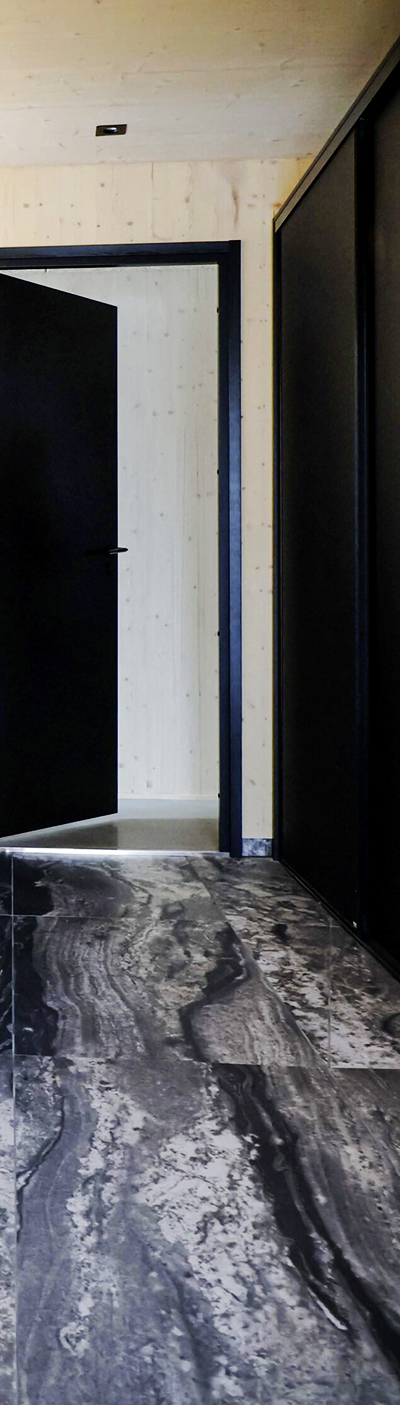
- Color and Pattern: The most striking feature of Copacabana marble is its complex patterns and veins intertwined in golden yellow, brown, white, and sometimes greenish tones on a black background. These patterns generally exhibit a wavy, moving, and fluid appearance, almost reminiscent of liquid metal flow.
- Density: With an average density of 2.7-2.9 g/cm³, it is a high-density natural stone.
- Water Absorption Rate: It has a very low water absorption rate (below 0.2%), which makes it waterproof and resistant to stains.
- Compressive Strength: With very high compressive strength (200-250 MPa), it is one of the durable members of the granite family.
- Wear Resistance: Shows excellent wear resistance, therefore ideal for high-traffic areas.
- Polishability: Mirror-bright surfaces can be obtained with superior polishability property.
Technical Properties
- Mohs Hardness Scale: Between 6-7
- Flexural Strength: 16-20 MPa
- Freeze-Thaw Resistance: Very high
- Thermal Conductivity: 3.0-3.5 W/mK
- Chemical Composition: Quartz, feldspar, mica, and other minerals
Geological Origin
Copacabana marble is actually a granite geologically. This stone of magmatic origin was formed as a result of molten magma slowly cooling and crystallizing under high pressure and temperature underground. The different minerals and elements it contains reveal its characteristic patterns and color diversity. The complex vein structure formed as a result of geological processes transforms each Copacabana block into a unique work of art.