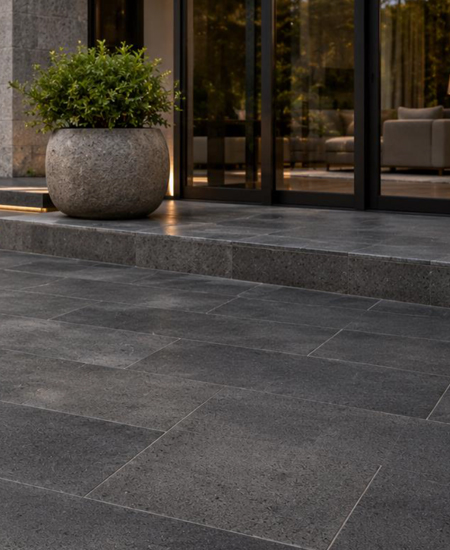
Basalt Flooring
Basalt Flooring
Basalt is a fine-grained volcanic rock formed by the rapid cooling of low-viscosity lava rich in magnesium and iron. It constitutes more than 90% of volcanic rocks on Earth. Basalt columns are stones that emerged from magma to the surface through volcanic eruptions that occurred 20-25 million years ago. Basalt stone, which is poor in silica but rich in iron and magnesium, is a prism-shaped lava rock.
Physical and Technical Properties
The prominent features of basalt flooring are as follows:
- It has technical properties such as high compressive strength, very low water absorption rate, resistance to freezing and heat, and durability against abrasion. Thanks to this, it can be easily used in outdoor environments.
- It is extremely resistant to wear, impacts, and temperature due to its high-density and hard structure.
- The composition of basalt includes basic feldspars such as augite macrolites, anorthite and labradorite, magnetite and olivine granules with amorphous substances, and sometimes substances like ilmenite and hornblende.
- The durability of the stone comes from substances such as iron, sulfate, magnesium, and olivine. These substances increase the durability of the stone.
- Real basalts are the world's most durable and strongest natural stones. It is one of the most preferred natural stones due to its properties such as resistance to abrasion and climate conditions.
Indoor Usage Areas
Basalt is an ideal material for designing areas in minimalist style and where nobility is at the forefront in modern interior projects. The natural tones of gray and black harmonize perfectly with modern designs.
Basalt can be used both in flooring and wall coverings. When used on the wall, basalt's dark and striking texture creates an elegant ambiance in the space, while on the floors, it creates a pleasantly textured carpet feeling.
As interior floor coverings, basalt stone gives spaces a modern and aesthetic appearance.
Outdoor Usage Areas
Basalt is frequently preferred in outdoor spaces due to its durability and resistance to harsh weather conditions. Its use is ideal especially on terraces, garden paths, and walking areas in outdoor spaces.
The durability of basalt stone as road and sidewalk stones offers long-lasting performance even in high-traffic areas.
It is seen that the desired results are much more successful with basalt flooring used in facade coverings, urban roads, sidewalks, garden landscaping, and many other areas.
It is used to provide an aesthetic appearance in open areas such as parks, gardens, and squares in landscape design. It is preferred as a safe coating material around pools in wet surfaces thanks to its non-slip feature.


